GPNet: A 20-Year Factory Grows a Storefront That Talks
海水不可斗量數位工作室 (OceanAds) is a digital operations studio based in Taichung, Taiwan, that provides website development, Google Ads management, SEO, and workflow automation for small and medium-sized businesses, built as one system so a brand can launch, take orders, track performance, and iterate. This case study covers GPNet, a precision packaging materials factory, and the commerce platform we built to replace its decade-old spec-sheet website.
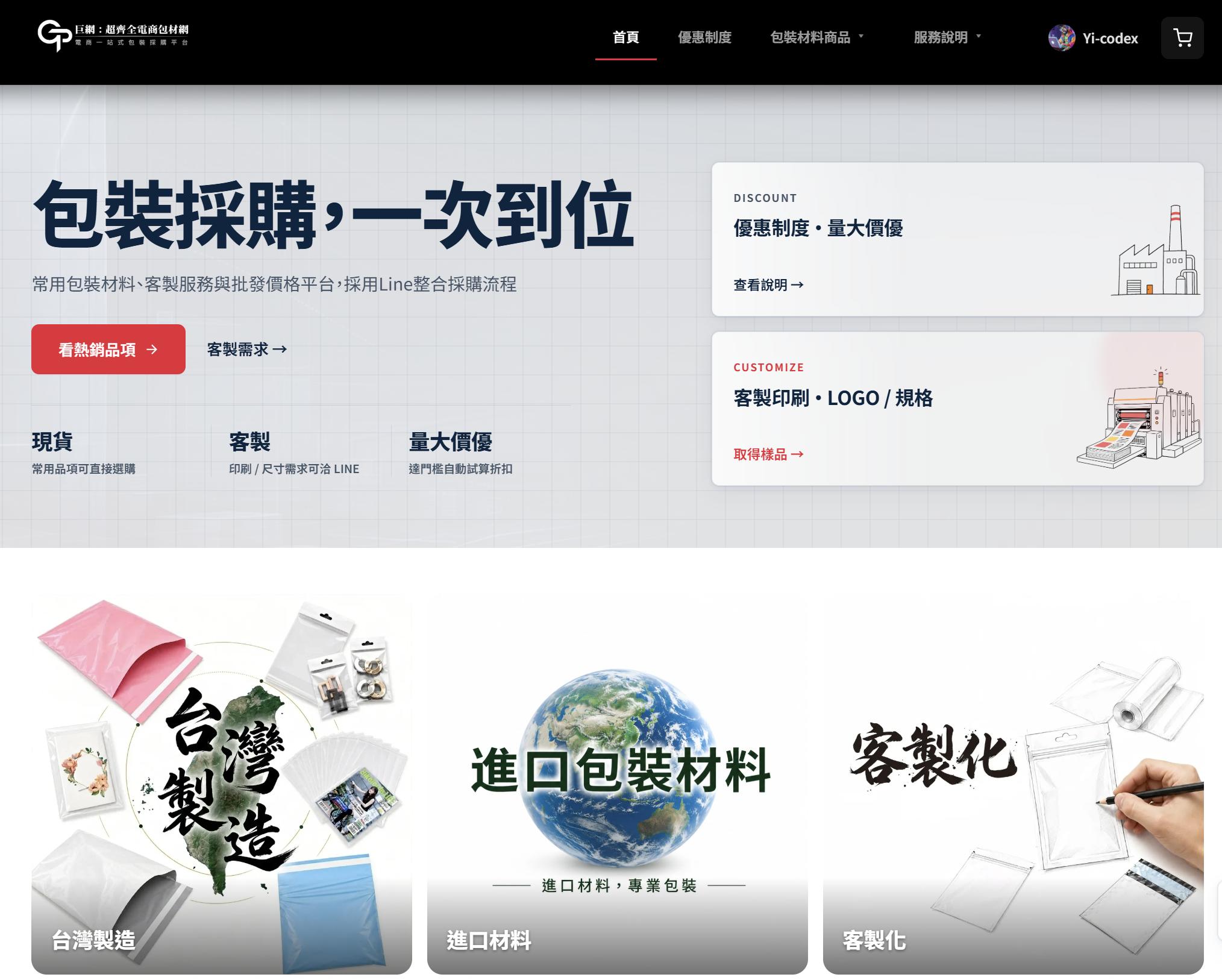
The Brief, in the Owner's Words
GPNet has manufactured packaging materials — OPP bags, courier bags, stand-up pouches, custom printing — since 2006. Its old ASP.NET website worked, but as the owner put it, it looked like a price list taped to a factory wall: existing customers kept ordering, new visitors could not tell what the company was capable of. His one-sentence brief became the project's compass:
"I don't need a flashy website. I need a website that makes a customer willing to place an order directly."
That translated into four operational problems: customers ranging from craft hobbyists to monthly-container wholesalers who cannot be shown the same pricing; an AI assistant that must never guess about material safety; custom-print inquiries that used to die in phone-and-fax purgatory; and 5,274 legacy customer records that could not lose a single entry.
Two AIs, Not One — and Hard Guardrails
The obvious build — one chatbot for everything — fails here, because answering product questions and collecting a custom-quote inquiry are opposite conversations. So the platform runs two fully independent assistants:
- A floating support AI that answers what can be answered safely: product specs, public retail prices, stock, shipping times, and order status.
- A custom-quote intake AI on a dedicated page that works the other direction — asking item type, dimensions, quantity, and contact details step by step, then assembling a summary the customer confirms before sending.
The guardrails were negotiated with the owner line by line across two afternoons, then enforced in code, not just in the prompt. The AI does not answer heat or acid tolerance questions, does not quote custom work, does not promise delivery dates, and does not assess sampling feasibility — packaging specs answered wrongly can mean an entire spoiled shipment. When a question crosses the line, the AI says a salesperson will confirm, and means it. One more hard rule: no lead is ever created without a contact method. An inquiry the owner cannot call back is noise, not a lead.
When an inquiry completes, the owner's phone receives a LINE Flex card — item, quantity, contact name, phone, spec summary, and a button into the back office. From a customer opening the page to the owner holding a qualified lead takes under 5 minutes. The AI's system prompt itself lives in an admin interface with versioning, so the owner tunes his assistant's personality without calling an engineer.
Pricing Logic a Customer Can Understand
Instead of a permanent VIP ladder that quietly bleeds margin, membership runs on a 30-day rolling window — recent purchasing earns the discount, lapsed purchasing releases it. The thresholds came from the owner's twenty years of customer knowledge, not from us:
- Gold VIP: NT$8,000 in 30 days → 3% off. Platinum: NT$13,000 → 5% off. Black Diamond: NT$20,000 → 8% off.
- Cart-level retail discounts (5+ units and 35+ unit tiers) never stack onto wholesale prices — the two discount layers are computed separately so checkout math stays legible.
- Monthly-billing eligibility is computed automatically — NT$10,000 over 3 months plus NT$20,000 over 6 months — with a live progress bar in the member center, and the owner can still manually approve exceptions.
The migration was the least visible, hardest part: 3,738 registered members plus 1,536 unregistered customers in incompatible formats, with 483 phone-number collisions across tables. We normalized phones and addresses, imported 4,107 records automatically, and built a review screen where the owner adjudicated the 483 ambiguous merges himself — because some judgments only the person who knows the customers can make.
What This Case Demonstrates
Nothing in this project was a template feature. The discount boundaries, the AI's refusal rules, the no-contact-no-lead policy, the rolling VIP window — each encodes a business judgment the owner had been making by hand for twenty years. That is what we mean when we say a website should be an operating system rather than a brochure. Shortly after launch the owner sent us a message: a brand new customer had chatted with the AI, left a spec and a phone number, and become a lead — the kind of visitor who used to glance at the old site and leave. The full Chinese narrative of this project is on our blog.
Case FAQ
Q: How do you stop an AI assistant from giving customers wrong answers?
By deciding with the owner, line by line, what the AI may and may not answer — then enforcing it in code, not just in the prompt. GPNet's AI answers specs, public retail prices, stock, and order status; it is blocked from material tolerance judgments, custom quotes, delivery guarantees, and sampling feasibility, and routes those to a salesperson.
Q: Why use two separate AI assistants instead of one?
Because answering product questions and collecting a custom-print inquiry are opposite conversations — one answers, the other asks. Merging them produces confused dialogues and duplicate lead notifications, so the floating support AI and the custom-quote intake AI run as fully independent systems.
Q: What happened to the factory's old customer data?
All 5,274 legacy records were processed: phone numbers and addresses were normalized, 4,107 members and customers were imported automatically, and 483 cross-table duplicates were routed to a manual review screen so only the owner — who knows his customers — decided which records merged.